
“Intelligence-led retailing is essential and not optional anymore”
By Himanshi Jain | December 05, 2025
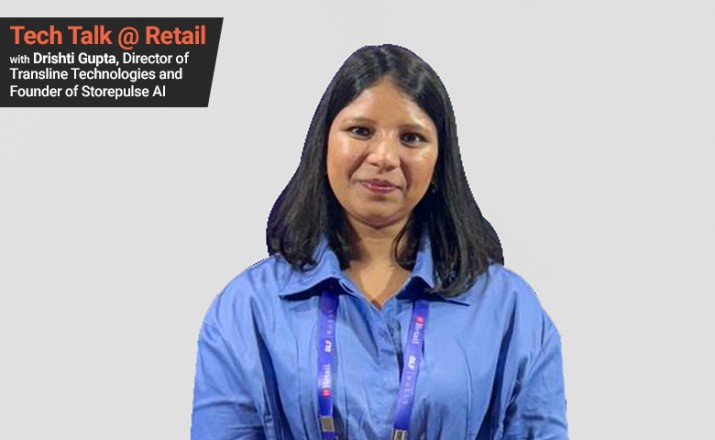
In an insightful conversation with Retail4Growth, Drishti Gupta, Director of Transline Technologies and Founder of Storepulse AI, shared how data-led retail and real-time visibility are rapidly redefining store performance and customer experience.

Retail is entering an era where operational precision and data-driven intelligence are no longer competitive add-ons. They are becoming foundational pillars for sustainable growth. As consumer expectations escalate and footfall patterns become increasingly unpredictable, retailers across tiers and geographies are accelerating their shift towards intelligent and tech-led ecosystems. The sector is converging toward a unified belief that the future of retail will be built on real-time visibility, automated insights, and personalised engagement happening directly inside the physical stores.
In an insightful exchange with Retail4Growth, Drishti Gupta, Director of Transline Technologies and Founder of Storepulse AI, shared how technology adoption is reshaping modern retail operations.
A sector moving towards intelligence-led growth
Retailers today are no longer satisfied with surface-level performance metrics. They want granular clarity on what is happening inside their stores, irrespective of whether the store is in a metro city or a tier-3 high street in Kerala.
“When a retailer has 20, 30, or even 40 stores across India, manual visibility becomes impossible. They need to know who is walking in, what age groups are coming, which zones perform better, and how long customers spend inside the store.”
This shift signals that physical stores are beginning to demand the same level of analytics that e-commerce has relied on for years.
The push for accurate and real-time insights
Across categories, be it apparel, footwear, electronics or grocery, retailers share a common struggle, i.e. dependence on inconsistent manual reporting. Store managers may misestimate footfall, understaffed floors may slow conversion, and SOP deviations can quietly chip away at revenue.
Drishti explains with an example, “A brand believed its conversion rate was nearly 50% based on self-reported footfall. But once analytics were introduced, the actual number turned out to be only 12%. Once they saw the real data, they were able to work with their team, recalibrate their approach, and improve the conversion to 20% within a month.”
Smaller retailers are also joining the transformation curve
Interestingly, the appetite for smart store intelligence isn’t limited to retail giants. Drishti points out that even brands with one or two outlets, especially those transitioning from online to offline, are demanding analytics to understand how their stores are performing.
“They are used to Google Analytics to Shopify-level insights. They want the same visibility offline because their investors want it too,” she explains.
A new era of store operations
Retailers are also rethinking their approach to operations. Drishti shares that retailers often underestimate the revenue lost due to late openings, early closings, or staff not being present on the floor after marking attendance.
Fortunately, with data-backed visibility into opening times, entry-exit logs, and employee floor presence, retailers are now able to optimise operations with a precision that was earlier unthinkable. “If your store is supposed to open at 10 but opens at 10:20, that’s direct revenue loss. Technology gives retailers the control they never had,” she notes.
Looking ahead
The next five years will push retailers toward deeper digital maturity, where analytics, automation, and human-centric design work in tandem. As Drishti shares that resistance to AI is already declining because the industry now understands that intelligence-led retailing is essential and not optional anymore.
“The world is moving toward personalised experiences. Retailers who use technology to elevate the in-store journey will win. This won’t remain a want; it will become a need,” she says.
Solutions like Storepulse AI, built on software-first, camera-agnostic frameworks, reflect how the sector is shifting toward scalable models that don’t burden retailers with heavy infrastructure. Its trajectory signals that retail technology is becoming increasingly accessible.
As conversations across the ecosystem grow, and as more retailers explore such tools, store intelligence will be as foundational as POS systems or billing counters.







Comments