gOGig decodes the rising demand for field intelligence platforms
By Chanda Kumar | June 29, 2026
As retail brands seek greater visibility into on-ground execution, Deepak Bansal, Founder & CEO of gOGig, explains how field execution intelligence is helping enterprises verify, monitor, and optimize offline marketing in real time.
India's retail landscape ranges from neighbourhood kiranas to large-format modern trade stores. Brands invest heavily in distribution and shelf placement across this footprint, but verifying whether that investment actually shows up on the ground remains one of retail marketing's most persistent blind spots, prompting a new category of software built to close that gap: field execution intelligence.
We spoke with Deepak Bansal, Founder & CEO of gOGig, a field execution intelligence platform now used by enterprise brands across retail, FMCG, QSR, BFSI, and real estate, to understand the demand behind this shift.
Current challenges
Today, verifying on-the-ground execution typically means field agents photographing and GPS-tagging their work, sharing images over WhatsApp, and having someone manually compile them into reports that are checked before payment. “What should take a week or so often stretches into months,” Deepak says. During all that time, the brand has had zero visibility into whether the branding actually exists in the market.
The deeper issue, he argues, is trust. “There was no way to confirm whether a submitted photo genuinely reflected the work done. Photos could be staged, reused, or even edited with AI to alter the date and timestamp, with no way to detect it,” he adds.
What these platforms solve
Field intelligence tools capture proof of work the moment it happens and verify it independently rather than trusting documentation after the fact.
Speed - A photo showing a lapse or gap can appear instantly on a dashboard for approval, compressing cycles that once took 30-plus days down to roughly three. “The moment a field agent photographs a gap, it appears instantly,” says Deepak. Both the agency and the brand see the same data on their respective dashboards in real time, so there's no lag between the work happening and it being checked.
Authenticity- Independent verification of date, time, and location data removes the ability to fake or backdate submissions.
Accountability without lag - Previously, agencies often discovered fabricated work only after a brand's delayed audit, by which point the field worker had moved to another project, leaving the agency to absorb the cost. Shared, real-time dashboards close that gap.
Real-time correction - If a photo is hazy or substandard, the system prompts an immediate retake. “The intent is to support agents working honestly and in good faith, not to penalise accidental mistakes,” Deepak notes.
Benefits across the chain
For brand marketers, the shift is largely evidentiary. Offline marketing has long lacked the granular proof digital channels offer, leaving marketers at a disadvantage when defending budgets. Verified execution data lets brands show leadership, “exactly what was done, how, and with what results. Adding to this, Deepak says, “Marketing teams benefit because, for the first time, offline/BTL spend becomes as data-backed and accountable as digital marketing spend, which has historically had far more measurement tools than offline activity.”
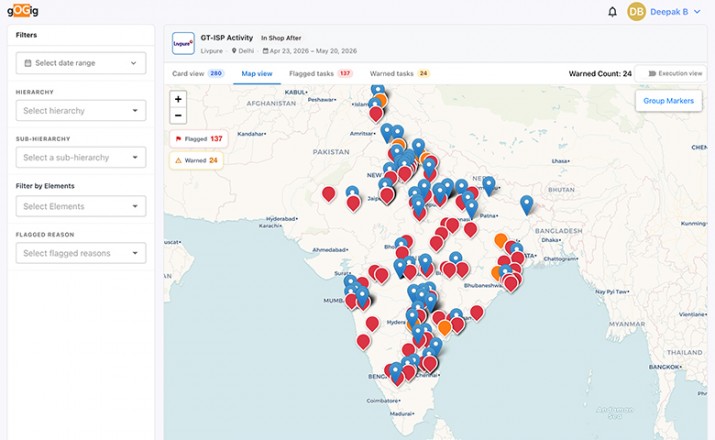
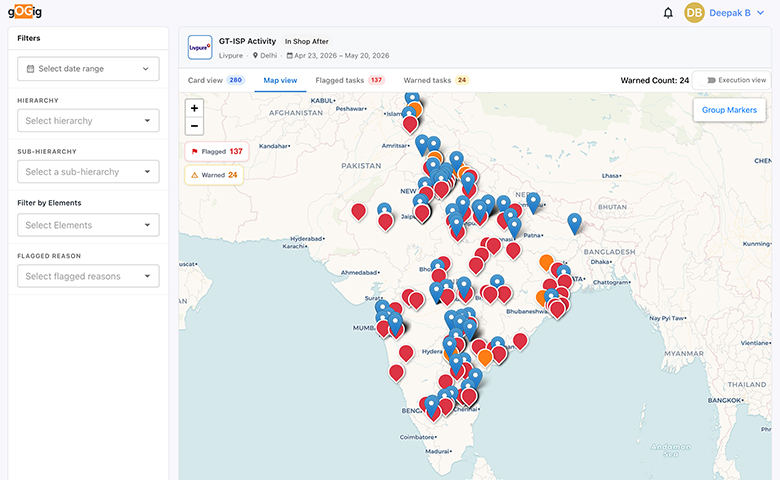
Speaking about the company’s ongoing work with LivPure, Deepak shares that while the brand has retail display units across roughly 10,000 stores, the confidence in correct product placement is typically low. Through field execution intelligence like gOGig, salespeople can photograph displays for AI verification, where the platform can automatically flag non-compliant stores, those without the flagship product on display and track corrective follow-ups easily.
For field representatives, the reaction is often relief rather than resistance, since manual reporting was tedious work nobody wanted to do. These tools are also built for outsourced, non-tech-savvy workforces. “There is no need for app download, no registration, no extra steps, just a photo sent over WhatsApp,” says Deepak while talking on gOGig, where every photo is checked using AI image analysis, with results streaming live onto a single dashboard, turning what used to be a quarterly audit exercise into a continuously updated, real-time picture of in-store reality.
For audit agencies, real-time shared visibility reduces disputes and protects against absorbing costs for work flagged, while giving brands comparable data on agency performance.
As outsourced and gig-based field operations grow across industries, the underlying demand isn't just digital record-keeping — it's verification that every party in the chain can trust without taking anyone's word for it.